%20(1).png)

Why LGBTQ+ Teens May Not Feel Safe in Therapy—Even When They Want Help


A teen can want support and still feel unsure about therapy.
They may say they do not need it. They may shrug through the first session, answer every question with “I don’t know,” or ask exactly what will be shared with their parents before saying anything meaningful.
This does not necessarily mean they are unwilling to participate. Often, it means a protective part of them is trying to answer a very important question:
Is it actually safe to be fully known here?
For LGBTQ+ teens, that question may carry extra weight. They may have already been misunderstood, judged, pressured to explain themselves, or treated differently after sharing something personal. Even when a therapist describes their practice as welcoming, a teen’s nervous system may need more than reassuring words before it believes them.
If you are an LGBTQ+ teen, your hesitation makes sense. If you are a parent trying to help, your teen’s guardedness does not mean you have failed—or that therapy will not work. Trust can grow when it is given time, choice, and room to become real.
Why LGBTQ+ Teens May Be Cautious With a Therapist
LGBTQ+ identity is not a mental health problem. The distress many young people experience is often connected to rejection, bullying, discrimination, pressure to hide, or uncertainty about how others will respond.
The Trevor Project’s 2025 national survey emphasizes that LGBTQ+ young people face greater mental health risks not because of who they are, but because of mistreatment and stigma. It also highlights the protective power of spaces where young people feel welcomed and accepted.
That context follows a teen into the therapy room. A young person may silently wonder:
Will this therapist really respect my name and pronouns?
Will I have to educate them about my identity?
Do they think being LGBTQ+ is the problem?
Will they tell my parents everything I say?
Can I talk about anxiety, school, friends, or family without every concern being blamed on my identity?
Will they support me if I am questioning and do not have a label?
What happens if my parents and I understand things differently?
A teen may be studying the therapist’s language, facial expressions, paperwork, office, and response to small disclosures before deciding how much of themselves to bring into the room. What looks like resistance may actually be careful self-protection.
“LGBTQ+ Friendly” and LGBTQ+ Affirming Are Not Always the Same
Many therapists sincerely want LGBTQ+ clients to feel welcome. But genuine affirmation is more than avoiding openly judgmental language or displaying a rainbow symbol.
An LGBTQ+ affirming therapist should be able to:
Use a young person’s name and pronouns without making them feel burdensome
Understand that sexuality and gender are related but distinct
Make space for questioning, fluidity, uncertainty, and changing language
Avoid assuming that every struggle is caused by LGBTQ+ identity
Recognize the effects of minority stress, bullying, rejection, and masking
Talk clearly about privacy and its limits
Work thoughtfully with parents while protecting the teen’s therapeutic space
Notice how culture, race, religion, disability, and neurodivergence may intersect with identity
Continue learning without expecting the teen to become the teacher
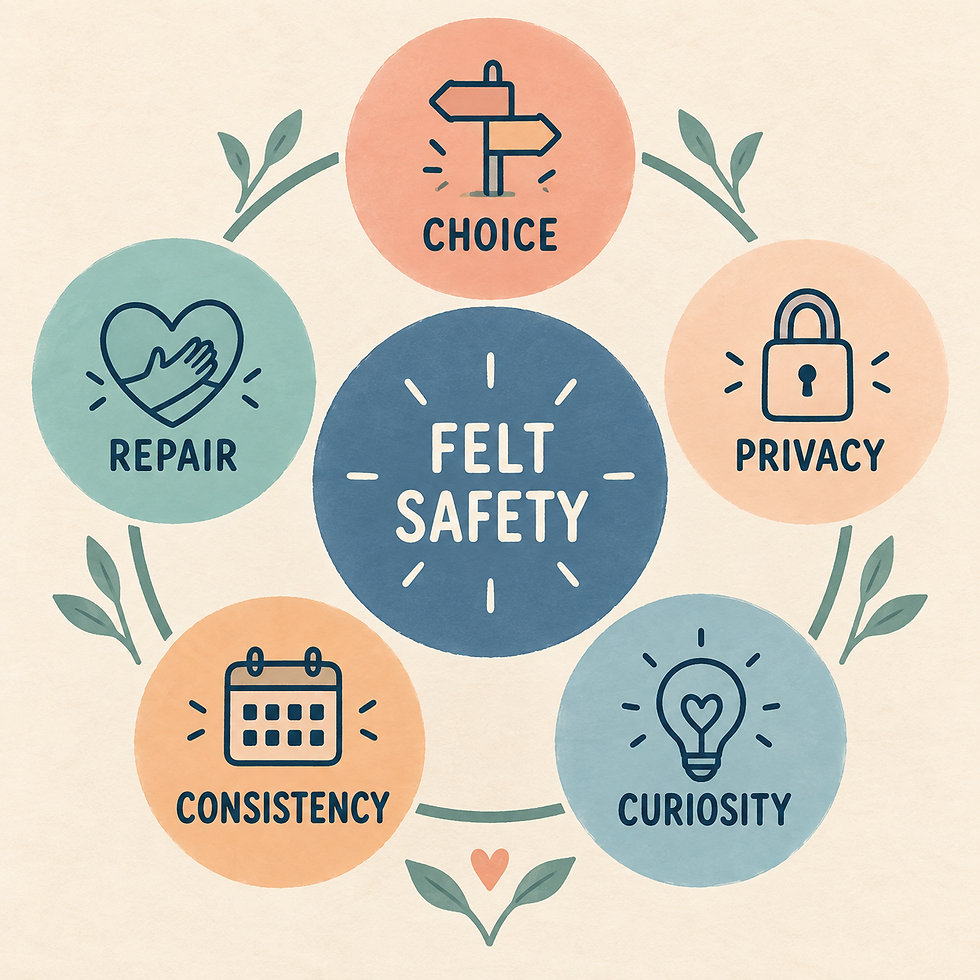
Safety is not something a therapist can declare for a client. It is something the therapist helps build through consistency, humility, repair, and respect.
What I Have Learned About Safety as a Queer Therapist
As a queer therapist, I know that reading the words “LGBTQ+ affirming” does not automatically quiet the part of someone that has learned to scan for danger.
In my work, I repeatedly notice that young people are not only listening to what an adult says. They are watching what happens when they disagree, correct us, become quiet, change their mind, or reveal something we did not expect.
That is often where safety becomes believable.
Does the adult become defensive—or curious? Does the teen have to manage the adult’s feelings? Are they allowed to say, “That word doesn’t fit me,” or “I’m not ready to talk about that”? Can they be a whole person whose life includes humor, creativity, friendships, school stress, family conflict, anxiety, neurodivergence, and ordinary teenage uncertainty?
For me, affirming therapy is not about pushing a young person toward a particular identity or outcome. It is about creating enough room for them to hear themselves more clearly and relate to every part of who they are with less fear and shame.
An IFS Perspective: The Guarded Part Is Not the Problem
Internal Family Systems, or IFS, begins with the idea that we all have different “parts.” A teen might have one part that longs to be understood and another that warns, Do not trust too quickly. One part may want to tell a parent everything, while another fears losing privacy, connection, or control.
These parts are not evidence that something is wrong with the teen. They are often trying to protect something tender.
In therapy, I do not believe that guardedness needs to be broken down. Instead, we can become curious about it:
What is this protective part worried might happen?
What has it learned from earlier experiences?
What would help it feel one degree safer?
What choices does it need to have?
When young people discover that they will not be rushed, corrected, or forced to disclose, their protective parts may gradually become less vigilant. Trust develops because the therapist respects the protection—not because the teen is pressured to abandon it.
What Parents Can Do to Help Therapy Feel Safer

Parents often seek therapy because they love their teen and are worried. That concern is meaningful. But urgency can sometimes feel like pressure to a young person who is already unsure whether adults will listen.
You do not have to understand every part of your teen’s experience immediately to become a safer person to bring it to.
1. Let therapy belong partly to your teen
Parents should receive clear information about safety, treatment goals, and how caregiver involvement will work. At the same time, teens usually need an age-appropriate degree of privacy in order to speak honestly. Ask the therapist to explain confidentiality and its limits to everyone at the beginning.
2. Ask about support instead of demanding disclosure
Rather than asking, “What did you talk about?” consider:
“Is there anything you want me to understand or do differently this week?”
This gives your teen a choice while keeping the door open.
3. Treat corrections as connection
If your teen corrects a name, pronoun, or assumption, try to receive it as information rather than criticism. A simple “Thank you for telling me” can build far more trust than a long explanation of your intentions.
4. Make room for your own feelings elsewhere
Parents can experience fear, grief, confusion, protectiveness, or worry about their child’s future. Those feelings deserve care, but your teen should not have to carry them for you. Your own therapist, parent support group, or informed resource can give those feelings an appropriate place to land.
5. Notice the whole person
Your teen is more than an identity and more than a problem to solve. Stay interested in their music, art, friends, humor, games, dreams, and the ordinary details of who they are becoming.
Family support is not a minor detail. The Family Acceptance Project’s research and family-support model connect accepting family behaviors with better health and well-being for LGBTQ+ children and teens.
Questions to Ask an LGBTQ+ Affirming Therapist
A consultation can help both parents and teens evaluate whether a therapist is the right fit. You might ask:
What experience do you have working with LGBTQ+ teens?
What does affirming care mean in your actual practice?
How do you handle confidentiality with teens and caregivers?
How do you respond when a parent and teen have different perspectives?
How do you support a teen who is questioning or does not want a label?
How do you involve parents without taking away the teen’s voice?
How do you approach anxiety, trauma, neurodivergence, or family conflict alongside LGBTQ+ identity?
What happens if my teen does not connect with you?
A trustworthy therapist should be able to answer directly, acknowledge the limits of their expertise, and welcome questions without becoming defensive.
What the First Session Can Look Like
The first session does not have to contain a dramatic disclosure or immediate breakthrough.
It may simply be a chance to meet, understand what brought you in, talk about privacy, and begin discovering what helps the teen feel comfortable. Some young people speak easily. Others connect through art, play, creativity, humor, or shared attention before direct conversation feels possible.
It is okay for trust to take time. A good beginning may sound less like “I told them everything” and more like:
“I did not feel judged.”
“They did not push me.”
“I think I could go back.”
Finding LGBTQ+ Teen Therapy in Concord, NC
At Heartbeat Therapy & Wellness, I offer LGBTQ+ affirming therapy for teens and families in Concord, North Carolina. My approach is warm, creative, neurodivergent-affirming, and informed by Internal Family Systems. I work to help young people understand their emotions and protective parts without treating their identity as something that needs to be fixed.
Parents do not need to have all the right words before reaching out. Teens do not need to know exactly what they want to discuss. We can begin by talking about what would help therapy feel safer and whether I seem like the right fit.
If you are looking for an LGBTQ+ affirming therapist for a teen in Concord, you are welcome to schedule a free 15-minute consultation. We can talk about your concerns, how privacy and caregiver involvement work, and what your teen might need from the process.
Every part of you is welcome here.
Start with a free 15-minute consultation for parents, teens, or both.
References for Claims in the Post
The Trevor Project, 2025 U.S. National Survey on the Mental Health of LGBTQ+ Young People: https://www.thetrevorproject.org/survey-2025/
Family Acceptance Project, San Francisco State University: https://familyproject.sfsu.edu/
American Psychological Association, 10 factors to consider when searching for a gender-competent therapist: https://www.apa.org/topics/lgbtq/gender-competent-therapist-considerations


Comments