%20(1).png)

Neurodivergent Couples Communication: Why You Keep Misunderstanding Each Other

Updated: Oct 1
By Erica Smalla, Certified IFS Therapist

You ask your partner what is wrong, and they say, “Nothing.”
You explain that you need reassurance, and they begin offering solutions. You want to talk through the conflict now because the distance feels unbearable. They need quiet and time because their thoughts have disappeared under the pressure.
One of you experiences the pause as abandonment. The other experiences the continued conversation as being cornered or pressured.
By the end, both of you may be thinking some version of the same thing:
If you really cared about me, why would you respond this way?
This is a painful place to reach, especially when the truth may be that both people care deeply. You may not be dealing with a lack of love. You may be dealing with two nervous systems, communication styles, and sets of protective parts that create safety in very different ways.
For many mixed-neurotype couples, the problem is not that either partner is unwilling to connect. It is that each person keeps sending care in a form the other person’s system does not easily recognize.
What is a mixed-neurotype relationship?
A mixed-neurotype relationship is one in which partners experience, process, or respond to the world differently because of their neurotypes. This might include an autistic and allistic partner, an ADHD and non-ADHD partner, or an autistic and ADHD couple. Some couples use the terms neurodivergent couple or neurodiverse relationship.
Formal diagnoses are not required for these differences to shape a relationship. Some people discover their neurodivergence later in life. Others identify patterns without pursuing an assessment. What matters in couples work is not forcing either person into a label. It is understanding the real needs, capacities, sensitivities, and communication patterns present between them.
No two autistic people, ADHDers, or allistic people are the same. Neurotype can help explain a pattern, but it should never replace curiosity about the actual person in front of you.

Why does neurodivergent couples communication break down?
Most of us interpret our partner through our own nervous system.
If eye contact helps you feel connected, a partner looking away may seem disengaged. If looking away helps your partner concentrate, they may actually be listening more carefully. Neurodivergent couples communication can feel confusing when both partners care deeply but process words, emotions, and conflict differently.
If you rely on tone, hints, or context, you may believe you have communicated a need clearly. A more literal partner may hear only the words you said. When they do not respond to the message beneath the message, you may feel ignored. They may feel blindsided when they later learn there was an unspoken expectation.
If talking helps you regulate, silence may feel dangerous. If reducing input helps your partner regulate, more talking may make it harder for them to think or speak.
None of these experiences is imaginary. The difficulty is that both people may use their own experience as proof of the other person’s intention.
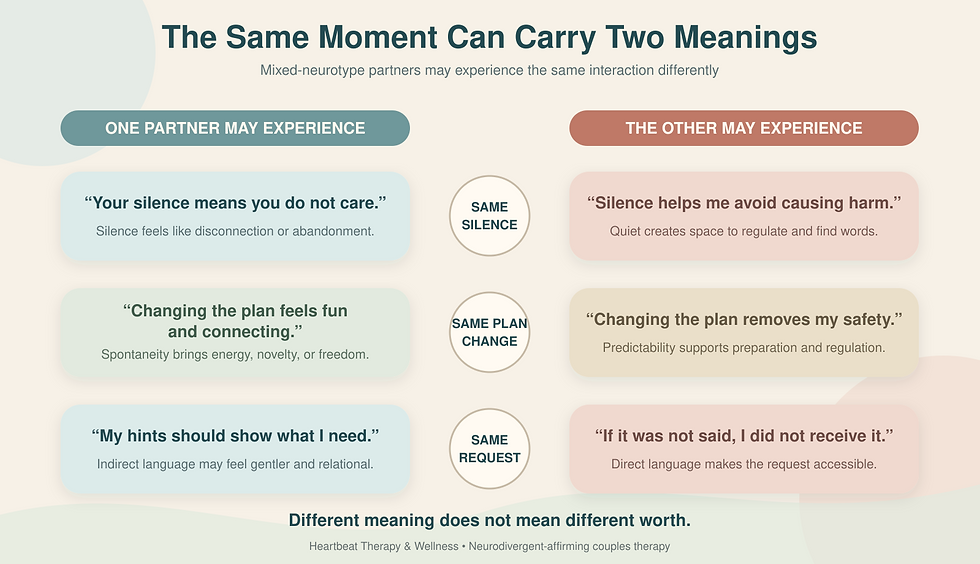
Researchers and autistic advocates sometimes describe this as the double empathy problem: when people experience and communicate differently, misunderstanding can occur in both directions. The autistic or otherwise neurodivergent partner is not automatically the one who lacks empathy. Both people may struggle to accurately read what the other person means.
That gives mixed-neurotype couples a more hopeful place to begin. Instead of asking, “Which one of us is the problem?” you can begin asking, “Where is the translation breaking down?”
The meaning we assign can hurt more than the difference itself
Consider a change in plans.
One partner may experience spontaneity as playfulness, freedom, and connection. The other may need predictability to prepare mentally, manage sensory energy, or feel safe. A last-minute invitation that feels exciting to one person may feel physically destabilizing to the other.
The conflict becomes more painful when the couple turns that difference into a character judgment:
“You are controlling.”
“You are inconsiderate.”
“You never want to have fun with me.”
“You do not care how your choices affect me.”
But the deeper truth may be simpler: one nervous system settles through flexibility, while the other settles through knowing what to expect.
The same pattern can appear around noise, touch, household tasks, social plans, emotional conversations, sex, alone time, or how quickly a problem needs to be resolved. The need itself is often workable. The belief that the need proves something terrible about your partner is what turns difference into injury.
An IFS perspective: the conflict is rarely just between two people
As a Certified IFS Therapist, I often listen for more than the words being exchanged. I listen for the protective parts that enter the relationship when connection begins to feel threatened.
One partner may have a part that urgently pursues conversation. It may believe, If we do not repair this now, I will be abandoned.
The other may have a part that shuts down, becomes highly logical, leaves the room, or loses access to speech. It may believe, If this continues, I will become overwhelmed, say the wrong thing, or lose control.
Then another round of parts arrives.
The pursuing partner’s frightened part may become louder because the withdrawal confirms its fear of being left. The withdrawing partner’s protective part may retreat further because the increased intensity confirms that the conversation is unsafe.
Soon, the couple is no longer discussing the original issue. Two protective systems are reacting to each other.
In Internal Family Systems therapy, we do not begin by deciding which part is bad. We become curious about what each part is trying to prevent. The urgent part may be protecting against disconnection. The shutting-down part may be protecting against overload, shame, or escalation. Both can have understandable intentions even when the cycle between them is causing real pain.
Understanding a protective response does not erase its impact. It does, however, make change more possible. Shame and blame tend to make protectors work harder. Curiosity gives them another option.
Why does my autistic or neurodivergent partner shut down during conflict?
What looks like refusal may sometimes be overload.
During an autistic shutdown or another form of nervous-system overwhelm, a person may struggle to find words, organize thoughts, interpret questions, track tone, or respond quickly. Asking more questions, repeating the point, or demanding immediate reassurance may further reduce their ability to participate.
At the same time, the partner waiting for a response may be experiencing genuine distress. Silence may activate a history of being ignored, punished, or emotionally abandoned. Telling that partner to “just give space” without reassurance or a plan may not feel safe either.
A pause works best when it protects both people.
Instead of disappearing indefinitely, the overwhelmed partner might say or text:
“I care about this, and I am too overloaded to talk well right now. I need 45 minutes. I will come back at 7:30.”
The other partner can practice treating the pause as part of the conversation rather than the end of it. The person taking space must then follow through. This turns withdrawal into a predictable regulation plan and gives the relationship somewhere to stand.
When one partner wants routine and the other needs spontaneity
An ADHD and autistic couple may encounter a particularly confusing push-pull.
The autistic partner may need advance notice, repetition, and reliable routines. The ADHD partner may need novelty, flexibility, urgency, or external stimulation to engage. One person’s regulation strategy can accidentally become the other person’s stressor.
This does not mean the relationship is incompatible. It means “meeting in the middle” may need to become more creative and specific.
For example:
Keep a few dependable anchors in the week while leaving one block intentionally open.
Give advance notice for important changes while allowing low-stakes choices to remain spontaneous.
Create quiet and stimulating zones rather than forcing the entire home to meet one sensory standard.
Divide responsibilities by capacity and strength instead of insisting that every task be split identically.
Put reminders, calendars, and routines outside both partners’ heads so one person does not become the other’s manager.
Fairness does not always mean sameness. A plan can be equitable while looking different for each person.
Emotional support may need to become more explicit
Many couples assume love should make support intuitive. In reality, even partners who share a neurotype can miss each other. In a mixed-neurotype relationship, relying on guesswork can create repeated disappointment.
“I need support” may mean:
Listen without solving the problem.
Tell me that my reaction makes sense.
Help me identify the next practical step.
Sit beside me without talking.
Ask before touching me.
Give me space, then check back at a specific time.
Remind me that we are okay even though we disagree.
None of these is the universally correct response. The useful response is the one the person needing support can actually receive.
Try replacing a test of intuition with a clear request:
“I do not need advice yet. Could you listen for five minutes and tell me what you hear me feeling?”
Or:
“I want to support you, but I am not sure what would help. Do you want comfort, ideas, practical help, or quiet company?”
Directness does not make care less meaningful. For many neurodivergent couples, clarity is an act of love.
A four-step reset for neurodivergent couples communication

When you recognize the familiar cycle beginning, try slowing it down with four questions.
1. What happened?
Describe the observable event without assigning intention.
“The plan changed an hour before we were supposed to leave” is different from “You never consider me.”
2. What meaning did each of us make?
One person may have heard rejection. The other may have thought they were offering flexibility. Neither interpretation should automatically be treated as the complete truth.
3. What is each nervous system or protective part trying to manage?
Look beneath the behavior. Is a part preventing overwhelm, criticism, abandonment, failure, loss of autonomy, sensory overload, or shame?
4. What specific agreement would help next time?
Create an agreement that can be observed and repeated. “Communicate better” is too vague. “Text me before changing evening plans, and wait for my response before confirming them” gives both people something usable.

The goal is not to eliminate every misunderstanding. It is to become better at repairing without turning difference into evidence that the relationship is doomed.
What neurodivergent-affirming couples therapy should—and should not—do
Neurodivergent-affirming couples therapy should not teach one partner to appear more neurotypical so that the other person feels comfortable. It should not assume that directness is cruelty, reduced eye contact is avoidance, a need for routine is control, or emotional intensity is manipulation.
It also should not use neurodivergence to dismiss hurtful behavior or unmet needs.
Good mixed-neurotype couples therapy makes room for both intention and impact. It helps each person understand their own internal system, communicate needs more explicitly, identify the cycle they create together, and build agreements that respect both partners’ capacities.
The goal is not to decide whose brain is correct. It is to help two people become safer translators of each other.
You may not be as disconnected as you feel
Repeated misunderstandings can convince both partners that they are fundamentally incompatible. But sometimes the love is still present underneath years of mistranslation, defensive reactions, and unmet needs.
The partner asking more questions may be reaching for closeness. The partner asking for silence may be trying to protect the conversation from becoming more harmful. The person who offers a solution may be attempting to show care. The person asking for validation may be trying to feel accompanied before taking action.
When couples learn to recognize the care hidden inside unfamiliar behavior, something begins to soften.
You do not have to communicate identically to build a connected relationship. You do need a shared language for your differences—and enough curiosity to keep translating.
If you are looking for neurodivergent couples therapy in Concord, NC, Heartbeat Therapy & Wellness offers neurodivergent-affirming couples counseling in person and online throughout North Carolina. As a Certified IFS Therapist, I help couples understand the protective patterns beneath conflict so that both partners can feel more seen, respected, and connected.
Frequently asked questions
What is a mixed-neurotype relationship?
A mixed-neurotype relationship is one in which partners have different neurological styles or identities, such as an autistic and allistic couple, an ADHD and non-ADHD couple, or an autistic and ADHD couple. The term describes difference; it does not determine whether a relationship will be healthy or successful.
Why do neurodivergent couples struggle with communication?
Partners may interpret language, tone, eye contact, silence, emotion, timing, and indirect requests differently. Misunderstandings often become more painful when either person assumes that a different communication style means a lack of care.
Why does my autistic partner shut down during arguments?
Some autistic people lose access to speech or organized thinking when emotional, sensory, or cognitive demands exceed their capacity. A structured pause with reassurance and an agreed return time can support regulation without abandoning the conversation.
Can an autistic person and someone with ADHD have a healthy relationship?
Yes. Autistic and ADHD partners may have conflicting needs around predictability, novelty, sensory input, time, or communication, but those differences can be approached through explicit agreements, environmental supports, and mutual respect.
How can neurodivergent couples communicate better?
Use direct requests, check what each person understood, discuss difficult subjects when both partners have capacity, create predictable ways to pause and resume conflict, and build concrete agreements instead of relying on unspoken expectations.
Does couples therapy work for neurodivergent couples?
Couples therapy can help when the therapist understands neurodivergence and does not treat one partner’s neurotype as the problem. Therapy should support mutual translation, regulation, repair, and practical accommodations for both people.
This article is educational and is not a substitute for individualized mental health care. Neurodivergent people and relationships are diverse; no single pattern applies to every person or couple.


Comments